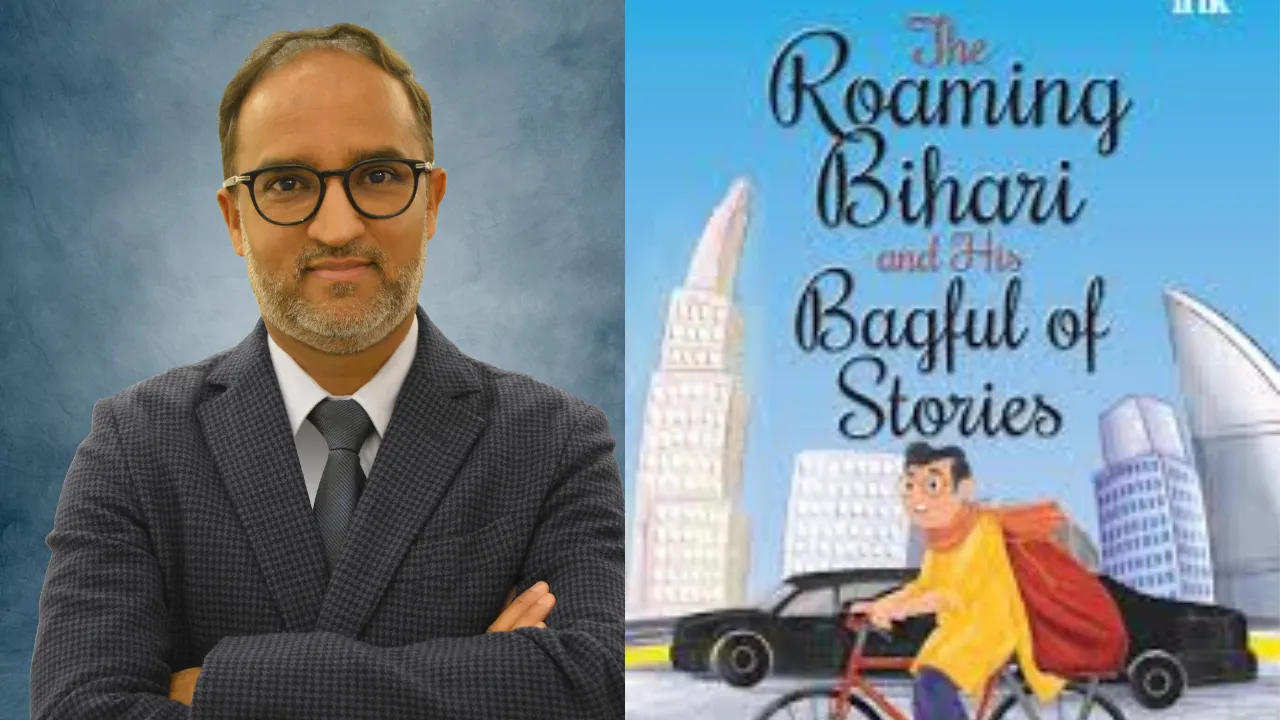
Roaming Bihari: 1 Man’s Journey Through Migration, Empathy and the Shared Human Story
There are books that announce themselves loudly, and then there are those that live quietly for years, gathering meaning, waiting for the right moment to exist. The Roaming Bihari and his bagful of stories belongs to the latter. For close to eight years, the idea lay dormant in a folder on Ehtesham Shahid’s computer—unfinished, half-formed, yet never abandoned. Somewhere in the back of his mind, he knew the story would surface when the time was right.
Two Lives, One Narrative Voice
That time arrived not as a dramatic breakthrough, but as a natural convergence of lived experience. Shahid’s life in the Gulf unfolded in two distinct yet complementary chapters: first as a journalist immersed in human interest stories, and later as a researcher and analyst working within think tanks. Together, these phases endowed The Roaming Bihari and his bagful of stories with both emotional depth and analytical clarity, allowing it to move seamlessly between lived experience and broader socio-political reflection.

Learning When to Let the Story Flow
At its heart, The Roaming Bihari and his bagful of stories is shaped by the diversity of expatriate life in the Gulf—an environment Shahid describes as endlessly enriching and quietly inspirational. Behind every migrant, he observed, lies a story of sacrifice: people leaving familiar worlds behind to improve their families’ futures. These narratives, often invisible in official discourse, became the emotional backbone of the book. Capturing them was not just an act of documentation, but one of empathy.
Questioning How We See the World
While the human stories ground the work, Shahid finds particular satisfaction in its analytical chapters. Years of observing social, economic and political change across a complex region culminate here, offering readers insight without moral grandstanding. Writing about places shaped by upheaval—such as Yemen, Iraq, Syria, and the reverberations of the Arab Spring—required patience and care, especially as events in these countries remain fluid and unresolved. Complexity, rather than certainty, became the guiding principle.

Empathy, Belonging and the Human Thread
The title The Roaming Bihari and his bagful of stories is not metaphorical. The narrative voice is explicitly that of a Bihari—someone from India’s state of Bihar—moving through different terrains, cultures and intellectual landscapes. This figure remains constant throughout the book: observing, analysing, and holding the narrative together as it ebbs and flows between journalism and geopolitics. In this sense, the Bihari is both author and lens, a steadfast presence in a shifting world.
Editing the Editor
Many of the book’s characters emerged organically from Shahid’s professional life. Some first appeared as people he interviewed while reporting; others took shape later as nation-states, policies and power structures encountered in academic work. In The Roaming Bihari and his bagful of stories, characters are both animate and inanimate, reflecting how individuals and institutions alike shape human destiny.
Beyond Borders and Singular Narratives
The writing process itself altered Shahid in subtle ways. He describes becoming more emancipatory and compassionate, a transformation he attributes largely to sustained engagement with human interest stories. While research and policy analysis demand emotional distance, storytelling insists on humility. Balancing these two worlds was one of the book’s quiet challenges.

Holding the Narrative Across Shifting Terrains
Yet the book is careful not to impose ideology. Shahid made a conscious effort to restrain his spiritual, philosophical and moral views, resisting the temptation to judge. Even for an experienced editor, this required discipline. Midway through the project, he realised that excessive control would reduce chapters to tightly edited articles rather than allowing them to breathe. Letting go—“flowing with the tide,” as he puts it—became essential to writing honestly.
Writing About Power, Conflict and Complexity
Ultimately, The Roaming Bihari and his bagful of stories is engaged in a conversation with society itself. It questions why we remain fixated on the mundane while ignoring extraordinary human achievements, and whether digital life has narrowed rather than expanded our vision. If the book were answering a single question, it would be this: why must we view the world through a single prism, instead of celebrating its inherent diversity?
The Bihari as Observer and Anchor
The emotional register Shahid hopes to awaken is clear—empathy, inclusivity, and accommodation. Beyond that, he wants readers to feel pride in their roots and a deeper sense of belonging, wherever they may find themselves. Human stories, he insists, do not belong to one geography or people. It is the shared nature of our strengths and frailties that binds us.
Human Interest at the Core of Roaming Bihari
In a world increasingly defined by division, The Roaming Bihari and his bagful of stories offers something quietly radical: the reminder that roaming does not mean rootless, and that understanding others begins with recognising ourselves in them.
Share your author story with us!
Share this content:

Post Comment